
Moody's Investors Service, while silent on the sovereign rating on the higher-than-expected fiscal deficit numbers, expressed doubts over attaining the higher revenue targets and divestment realisation as assumed in the Budget. The Union Budget 2021-22 has pegged a fiscal deficit of 9.5 per cent for the current financial year as against the consensus 7 per cent, and 6.8 per cent for 2021-22 with a market borrowing of around Rs 12 lakh crore. It also assumes Rs 1.75 lakh crore to be scooped up from divestment.
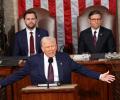
Trump has made it clear to Prime Minister Modi that India will not be spared from Washington's reciprocal tariffs and emphasised that "nobody can argue with me" on tariff structure.

'If it doesn't, it will continue with measures to infuse liquidity, signalling a new cycle,' predicts Tamal Bandyopadhyay.

'If the Trump administration decides to put guardrails on H-1B visas, that will surely impact both US and Indian firms.'

Since Sanjay Malhotra took office as governor in December, the Reserve Bank of India (RBI) has adopted a more accommodative stance, which bodes well for banking and the economy as they navigate a growth slowdown, according to analysts.

'It has also outlived its initial purpose of reducing physical gold imports.'

'There's a misconception that all Rs 1 lakh crore will be spent immediately, leading to higher consumption of FMCG goods, travel, and vehicle purchases.' 'While some of this money will go toward consumption, not all of it will.' 'The impact depends on where people deploy their savings.'

The most striking features of this Budget was its focus on simplification and improving the ease of doing business in India, asserts Kaku Nakhate.

The finance minister has stayed true to her commitment to fiscal consolidation, even though the pace of the decline in the deficit could have been faster, notes A K Bhattacharya.

The government of India had budgeted to bring down fiscal deficit to 4.8 per cent of GDP in the current financial year, from 4.9 per cent in 2012-13.


The finance minister could well be on her way to setting a record of achieving the biggest single-year reduction in the government's fiscal deficit, explains A K Bhattacharya.

Whether she will pare the fiscal deficit target of 5.1 per cent of GDP, using the record dividend received from the RBI, or expand flagship government programmes will be keenly watched.

India and the United States will finalize the contours, schedule of negotiations, and terms of reference for a proposed bilateral trade agreement (BTA) during a three-day meeting beginning Tuesday. The agreement is expected to be finalized in two tranches, with the first phase focusing on goods trade. The US team, led by Assistant US Trade Representative for South and Central Asia Brendan Lynch, will be in India from March 25-29 to discuss the agreement. Both countries are aiming to conclude the first phase of the agreement by fall 2025.

US budget deficit to come down to $583 billion in 2014

The impact of Trump's announcement of increasing import tariffs will have negligible benefit for India not because of companies trying to shift from China to other countries or their supply chains being affected due to their Chinese operations but because of our faulty policies, explains Mudit Jain.

Fitch on Tuesday affirmed India's sovereign rating at 'BBB-' with a stable outlook, on robust growth and resilient external finances, but said weak public finances remain a challenge. India's rating has been unchanged at 'BBB-', which is the lowest investment grade, since August 2006. "Fitch Ratings has affirmed India's Long-Term Foreign-Currency Issuer Default Rating (IDR) at 'BBB-' with a Stable Outlook," it said in a statement, adding strong growth potential is a key supporting factor for the sovereign rating.
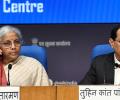
'Our attempt to honour the taxpayer has been since 2014 and more actively since 2019-2020 onwards.'

Union Finance Minister Nirmala Sitharaman, along with her team of bureaucrats, delved into the fine print of the 2024-25 Budget documents in a press conference, detailing the government's road map on bringing down the debt-to-GDP ratio and bold tax measures.

The fiscal deficit for 2015-16 may eventually come down to the targeted level of 3.9 per cent of GDP.

Instead of boosting growth, policy should focus on addressing the current account and budget deficits.
Ashok Chawla outlined the key thrust areas of Budget 2011.

Three years after India declared its goal to become a net-zero economy by 2070, the policy design for achieving the target has begun, with the NITI Aayog forming dedicated multi-sectoral committees to prepare a transition plan. In 2021, India joined a select group of nations that set a target year for becoming net-zero carbon economy. At COP26 in Glasgow, Prime Minister Narendra Modi outlined a five-pronged 'Panchamitra' climate action target for India and committed to a net-zero target by 2070, joining nations like the US, the UK, and China.

India's fiscal deficit trends are a bit like an alcoholic trying, unsuccessfully, to reform. Virtue does not last for too long, says Shankar Acharya.
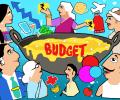
'We have essentially tried to set out an agenda for the next five years and it, in essence, represents the political commitment to that agenda.'

The government further said the gross tax revenue as a per cent of GDP is expected to increase to 12.1 per cent of GDP in 2019-20 and stabilise at that level in 2020-21 before climbing up to a level of 12.2 per cent of GDP.

India's exports grew by 67.39 per cent to $32.21 billion in May driven by healthy growth in sectors such as engineering, pharmaceuticals, petroleum products and chemicals, according government data released on Wednesday. Exports in May last year stood at $19.24 billion and in May 2019 it was at $29.85 billion, the commerce ministry's preliminary data showed. Imports in May rose by 68.54 per cent to $38.53 billion, from $22.86 billion in May 2020. In May 2019, imports stood at $46.68 billion.

It would be a miracle indeed if we grow at 7/8 per cent a year over the current and next few years, says A V Rajwade
Prime Minister Manmohan Singh on Wednesday termed the budgetary proposals for 2007-08 as anti-inflationary, which aimed to control prices through reduction in excise duty on many items.

Following are comments from economists at leading financial institutions, banks and rating agencies on the interim Budget:

The government should have mentioned clearly the specific structural reforms that were responsible for the deviation from the fiscal deficit target by half a percentage point, says A K Bhattacharya.
Several critics including some rating agencies have doubted prospects of meeting this ambitious fiscal deficit target.

With the fiscal deficit target staring at the government, the FY25 Budget has limited expenditure options, points out A K Bhattacharya.
Many lawmakers fear that things may get more toxic through a series of bitter struggles expected in next few months over nation's debt and deficit burdens.

The Budget should use the extra RBI surplus to better effect, suggests A K Bhattacharya.

Since Obama took office in Jan 2009, US shares have given annualised returns of 19%
May help US steer clear of recession, although enough austerity would remain in place to likely keep economy growing at lackluster pace.
Software body Nasscom expressed its disappointment over the budget as it has no fresh proposals for the USD 100 billion Indian IT-BPO sector even as the industry's request to exempt SEZ income from Minimum Alternative Tax has been ignored.

New investors should gradually build a 5 to 10 per cent allocation to gold.
